This guide is for businesses that need clear answers to the following questions about the New York Sales and Use Tax:
- Do I need to collect sales tax in New York?
- Should I be paying New York use tax?
- What do I do if I was supposed to collect but haven’t?
- I got a notice of audit from New York. What should I do?
- How to fight a New York sales tax assessment.
Who Needs to Collect New York Sales and Use Tax?
Like in most states, for your business to be subject to New York's sales tax collection and rules, it must:
- have nexus with New York, and
- sell or use something that is subject to New York sales tax.
How Do You Create Nexus in New York?
According to the New York Department of Taxation and Finance, sales tax nexus is created in New York if a business has a physical presence in New York, such as:
- Soliciting business in New York, including through the use of an employee or agent.
- Maintaining a place of business in New York (e.g., a storefront or office).
- Servicing tangible personal property in New York (e.g., installations or repairs).
- Performing certain services to real property in New York.
- Owning, renting, or leasing property, personal or real, in New York.
- Delivering goods to New York customers using your company-owned or leased truck.
- Maintaining inventory in New York using a third-party fulfillment service, such as Fulfilled by Amazon (“FBA”).
Also, a business that doesn't have a physical location in New York can establish economic nexus by making more money in the state than a certain amount each year. Details are in the next section.
Economic Nexus (Wayfair Law) And Internet Sales in New York
As of June 21, 2018, sales and use tax laws may also apply to businesses that aren't in New York. In particular, New York's Wayfair law says that a business that operates only outside of the state must sign up with CDTFA to collect and pay sales and use tax if it made more than $500,000 in sales of tangible personal property delivered into New York in the previous or current calendar year.
Which Sales Are Subject To New York Sales Tax?
General Transactions
If you have nexus in New York, the next step is to find out if the products or services you sell are subject to New York sales and use tax. Like most states, New York has a sales tax on sales and rentals of tangible personal property, unless the item is specifically exempt.
Even though the general rules seem simple, the details, complexities, and how they apply to your business can make New York's sales tax rules hard to follow. We suggest making an appointment with one of our sales tax experts to talk about your situation. Common exemptions from New York sales and use tax:
- Certain food and beverage items
- Drugs, medicine, and medical equipment
- Newspapers
- Feminine Hygiene Products
- Manufacturing machinery or equipment and associated utilities and fuel
Services
In New York, sales tax does not usually apply to services. But the following are some examples of services in New York that could be taxable:
- Certain information services
- Servicing or repairing real property
- Interior design services
To make things even more complicated, New York City taxes other services that are done in the city:
- beautician services, barbering, and hair restoring
- tanning
- manicure and pedicure
- electrolysis
- massage services
- services provided by weight control and health salons, gymnasiums, Turkish and sauna baths, and similar facilities, including any charge for the use of these facilities
- written or oral credit rating services
- oral credit reporting services not delivered by telephone
Software
Pre-written software is subject to a sales tax in New York, whether it is delivered on a physical medium or downloaded. Taxes do not apply to custom software. Software that can be used remotely and SaaS are usually taxed.
Shipping & Handling
New York has traditional rules with respect to shipping and handling charges. The basics are as follows:
Shipping of non-taxable items:
If the item being delivered is not taxable, the delivery charge is also non-taxable.
Shipping of taxable items:
When a taxable product or service is sold, any charge for shipping or delivery is also taxable.
Shipping of taxable & nontaxable items:
When both taxable and nontaxable items are combined into a single charge, the entire sale is taxable.
If the nontaxable charge is separately stated, sales tax does not apply to the nontaxable item.
Further, if the delivery charge is fairly allocated between the taxable and nontaxable items, only the shipping allocated to the taxable charge is taxable.
Industry-Specific Guides for New York Sales Tax
Even though the general sales tax rules seem clear, they can be hard to follow when gray areas exist in your industry. These guides were made by New York to give advice on specific industries and topics:
- New York Sales Tax Guide for Automobile Dealers / Car Dealers
- New York Sales Tax Guide for Hotel and Motel Operators
- New York Sales Tax Guide for the Film Industry
- New York Sales Tax Guide for Broadcasters
- New York Sales Tax Guide for Veterinarians
- New York State Sales Tax Guide - General
- New York Sales Tax Guide for Abstracts of Title and Other Public Records Searches
- New York Sales Tax Guide for Admission Charges
- New York Sales Tax Guide for Advertising Services
- New York Sales Tax Guide for Alcoholic Beverages Producers
- New York Sales Tax Guide for Amusement Parks
- New York Sales Tax Guide for Auto Repair and Body Shops
- New York Sales Tax Guide for Beauty Salons and Barber Shops
- New York Sales Tax Guide for Beverages Sold by Food Stores, Beverage Centers, and Similar Establishments
- New York Sales Tax Guide for Candy and Confectionery
- New York Sales Tax Guide for Capital Improvements
- New York Sales Tax Guide for Car Wash Services
- New York Sales Tax Guide for Caterers and Catering Services
- New York Sales Tax Guide for Printers and Mailers of Promotional Materials
- New York Sales Tax Guide for Contractors, Repair and Installation Services to Real Property
- New York Sales Tax Guide for Contractors – Sales Tax Credits
- New York Sales Tax Guide for Convenience Stores
- New York Sales Tax Guide for Coupons and Food Stamps
- New York Sales Tax Guide for Co-Vendor Agreements
- New York Sales Tax Guide for Customer Loyalty Cards
- New York Sales Tax Guide for Health Supplements
- New York Sales Tax Guide for Drugstores and Pharmacies
- New York Sales Tax Guide for Exempt Use Certificates
- New York Sales Tax Guide for Farmers and Horse Boarding Facilities
- New York Sales Tax Guide for Film Production
- New York Sales Tax Guide for Florists & Flower Sales
- New York Sales Tax Guide for Vending Machine Sales of Food and Drinks
- New York Sales Tax Guide for Food and Food Products
- New York Sales Tax Guide for Government Employee Occupancy of Hotel Rooms
- New York Sales Tax Guide for Gratuities and Service Charges
- New York Sales Tax Guide for Hair Removal Services
- New York Sales Tax Guide for Gyms, Fitness Centers, Health Clubs
- New York Sales Tax Guide for Hotel Services
- New York Sales Tax Guide for Industrial Development Agencies and Authorities
- New York Sales Tax Guide for Interior Decorating and Design Services
- New York Sales Tax Guide for Internet Data Centers (Web Hosting)
- New York Sales Tax Guide for Landscapers
- New York Sales Tax Guide for Machinery, Equipment, Materials and Services Used in Manufacturing or Production
- New York Sales Tax Guide for Manicures / Nail Salons
- New York Sales Tax Guide for Massage Services
- New York Sales Tax Guide for Materialmen Using Pay-When-Paid Option
- New York Sales Tax Guide for Fuels Used in Manufacturing or Production
- New York Sales Tax Guide for Cars, Motor Vehicles, Vessels, and Trailers
- New York Sales Tax Guide for New Businesses
- New York Sales Tax Guide for Newspapers and Periodicals
- New York Sales Tax Guide for Parking Services in New York City
- New York Sales Tax Guide for Storing Cars / Motor Vehicles
- New York Sales Tax Guide for Cigarette Tax Prepayment
- New York Sales Tax Guide for Production Equipment and Utilities Used by Supermarkets, Grocery Stores, and Delis
- New York Sales Tax Guide for Purchases by Restaurants, Bars, and Other Similar Establishments
- New York Sales Tax Guide for Qualified Empire Zone Enterprises (QEZE)
- New York Sales Tax Guide for Racehorses
- New York Sales Tax Recordkeeping Requirements
- New York Sales Tax Guide for Research and Development
- New York Sales Tax Guide for Residential Energy
- New York Sales Tax Guide for Capital Improvements and Repairs to Real Property
- New York Sales and Use Tax Penalties Guide
- New York Sales Tax Guide for Businesses Located Outside New York
- New York Sales Tax Guide for Temporary Facilities at Construction Sites
- New York Sales Tax Guide for Service Contracts and Warranties
- New York Sales Tax Guide for Medical Equipment, Supplies, and Prosthetic Devices
- New York Use Tax Guide for Businesses
- New York Sales Tax Guide for Utilities Used in Production
Determining Local Sales and Use Tax Rates in New York
Base or statewide sales tax rate in New York is 4%. But counties, cities, school districts, and transit authorities can also charge a sales tax. So, the total sales and use tax rate for a given sale is the sum of the state rate and any local taxes that apply.
In New York, a 0.375% tax is added to all taxable sales made within the Metropolitan Commuter Transportation District (MCTD).
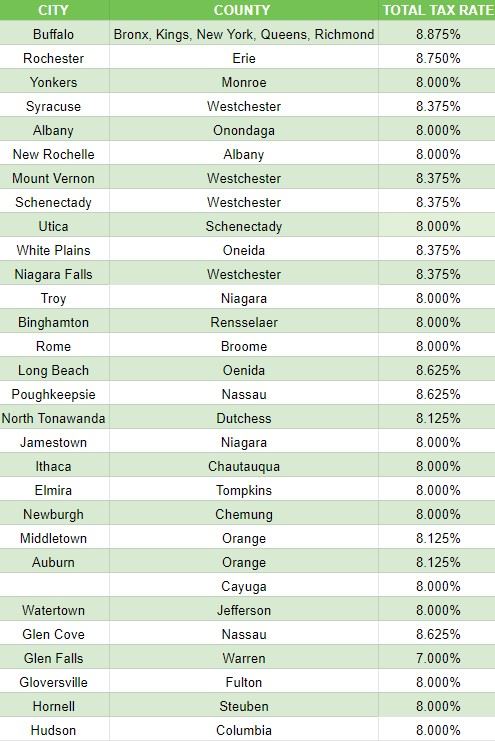
The district surtax is added to the price if the sale is made or delivered within the county. As part of New York's sales and use tax return, district surtaxes are sent to the state. As of August 1, 2019, the following table shows the combined sales and use tax rates for the 30 largest cities in New York and its counties.
Here is a complete list of New York’s local sales tax rates.
Nj Txrtc 2
Nj Txrtc 2
I Should Have Collected New York Sales Tax, But I Didn’t
If you determine your business has nexus but you have not collected New York sales tax, the primary options are to:
- Register and pay back taxes, penalties, and interest, or
- Enter into a VDA to eliminate penalties (and in some cases reduce your tax liability and avoid interest).
Unlike many of our competitors, who blindly suggest filing a Voluntary Disclosure Agreement (VDA) in every state, our sales tax experts will work with you to find the most cost-effective solution for your business.
Here is what you need to know about each option to make an informed decision about voluntary disclosure for your business:
Option 1: Register to Pay Back Taxes, Penalties, and Interest
Sometimes the best thing for a business to do is just to register with New York and pay back taxes, penalties, and interest. A VDA is not worth the money if accrued liabilities and penalties are small. Be wary of tax experts who tell you to do a VDA in these situations. They want to make money instead of looking out for your best interests. If you don't know what your past liabilities are, contact us. One of our state tax experts will work with you to do an analysis and help you make the best decision for your business.
When to consider registration and payment:
- Your nexus is less than 3 years old.
- The sales tax penalty is LESS than the professional fees charged for the VDA.
- Your business does NOT have a sales tax collected issue.
*Note: registering does not eliminate past liabilities and your business will be responsible for their payment to the NYDTF.*
Option 2: Voluntary Disclosure Agreement (VDA)
New York’s VDA lookback period: 3 years.
Voluntary disclosures are often a good way to cut down on long periods of past exposure. For example, if you should have been collecting sales tax for 10 years but didn't, the voluntary disclosure limits the lookback period (and associated liability) to 3 years. So, the benefit of doing a VDA usually depends on:
- Whether the VDA would limit your lookback period. i.e. – your nexus is more than 3 years old.
- The sales tax penalty savings is MORE than the professional fees charged for the VDA.
- You have a sales tax collected but not remitted issue.
I Received a New York Sales and Use Tax Audit Notice, What Should I Do?
Businesses required to charge, collect, and pay taxes in New York are audited regularly based on a variety of factors like past compliance, industry, and random selection. When a business gets a notice of a sales and use tax audit, they should think about:
- How can you be sure that the state's auditor is following the rules and doing things the right way if you haven't dealt with New York sales and use tax audits before?
- How will you know when to push back or when to give documents?
- Do you have a good idea of where your sales and use tax risks lie?
- Controlling the audit is the most important thing you can do to limit your risks and shape the results. Are you able to do that by yourself?
If you don't know the answers to these questions and don't have any experience with New York sales tax audits, you might want to hire a professional.
Contact us to find out how our sales tax experts can give you the confidence and peace of mind you need during your audit.
Please visit our resource pages for more detailed information and to help you make important decisions during your New York sales and use tax audit.
New York Sales Tax Audit Process
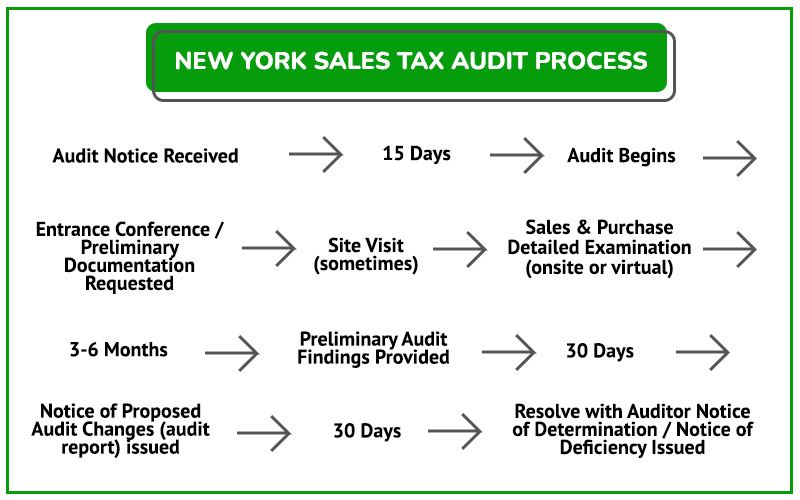
The audit process usually follows the steps in the flowchart below. See the detailed guidance for each stage to understand the administrative aspects of the process and the expected timeline between steps.
Audit Process Graphic NY
Audit Process Graphic NY
What to Expect After You Receive a New York Sales and Use Tax Audit Notice
A New York Department of Taxation and Finance sales tax auditor will often call to inform you of audit selection. Shortly after the phone call, your business will receive an audit notice for either a field or desk audit, which provides formal notice. To prepare for the audit, it is generally advisable to start by speaking with a state and local tax professional.
What to Expect From A New York Sales Tax Auditor
- The auditor will conduct pre-audit research.
- The auditor will often schedule an entrance conference.
- The auditor will request records — many of which the auditor may not be entitled to review as part of the audit.
What Happens During the New York Audit
Most New York sales tax audits cover the prior three years. An audit can take anywhere from a few days to a year or more, depending on the complexity of the business and the completeness of its records.
Once the auditor has the necessary records, they will:
- Compare your New York sales and use tax returns to your federal income tax returns and bank statements to verify that all applicable sales were reported.
- Review your exempt and out-of-state sales, including the supporting exemption certificates (resale, manufacturing, capital improvement, governmental, etc.).
- Conduct a use tax audit on business expenses such as advertising, auto and truck expense, repair and maintenance, rent (including related-party rent), office expense, miscellaneous expense, supplies, and equipment.
Despite publications to the contrary, if a business buys an item online without paying use tax, the business still has an obligation to remit New York use tax. This often produces surprise assessments during a New York audit.
*NOTE: A slight error in how tax was charged on even a single type of transaction, when multiplied over many years, can create a considerable New York sales tax liability.*
After the Audit — Understand and Defend Your Business's Rights
After the fieldwork is complete, the auditor will hold an exit conference and produce an audit report — a Statement of Proposed Audit Changes — together with the supporting workpapers. It is advisable to have a sales tax professional present at this conference: this is the first opportunity to push back on areas where the auditor overstepped or misapplied New York's sales tax laws.
We recommend that businesses refrain from signing the Statement of Proposed Audit Changes or the subsequent Notice of Determination/Deficiency until a sales tax professional has reviewed the audit report for issues that should be challenged. The consequence of premature agreement is drastic overpayment — owners and in-house accounting staff often miss flaws that, if challenged, could materially reduce New York sales tax liability.
The next several sections cover the formal process for challenging a New York sales tax audit assessment.
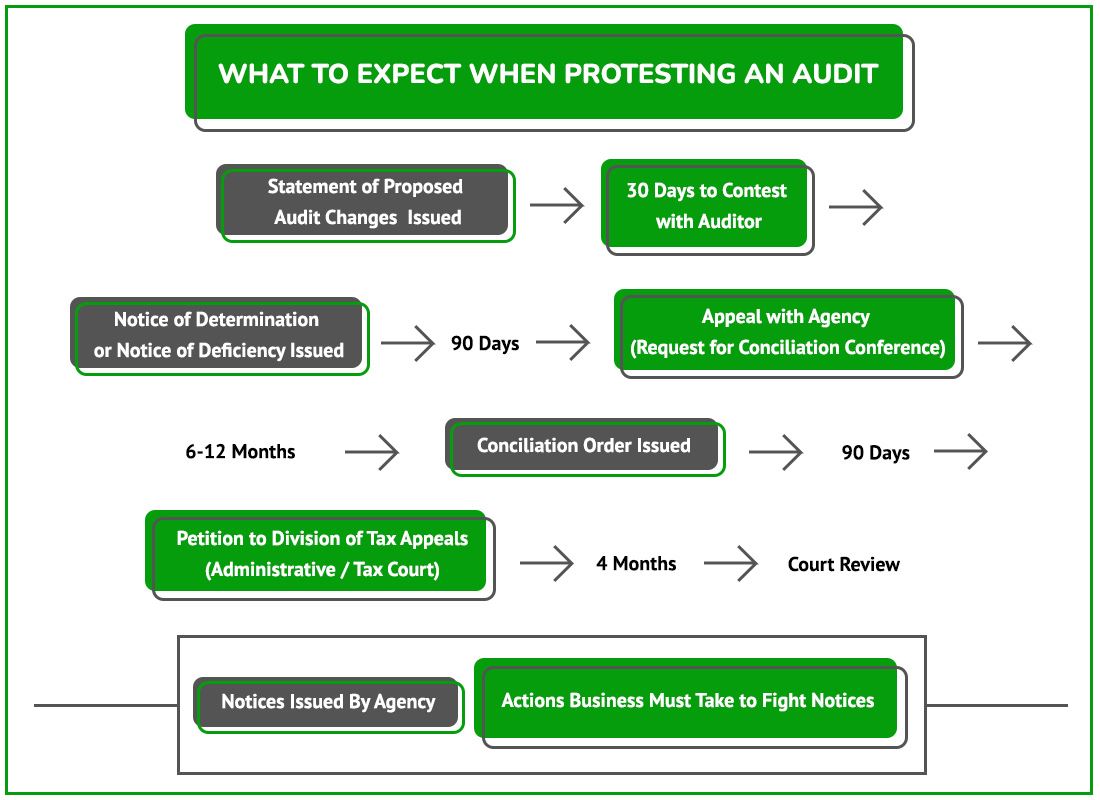
New York Sales Tax Audit Protest Flow Chart
Protest Audit Graphic NY
Protest Audit Graphic NY
NOTE: A conciliation conference is the most effective informal way to settle a New York sales tax audit. If you cannot resolve the case through conciliation, you can still petition the Division of Tax Appeals for a formal hearing.
Contesting New York Audit Findings with the Auditor
After the audit, the auditor will issue a Statement of Proposed Audit Changes (the audit report). This document details the auditor's findings, so it is important to carefully review and understand the implications. Any issues with the results are handled as follows:
- Your business has 30 days to disagree with the auditor's findings.
- Documentation issues — exemption certificates, proof of tax paid, calculation errors — are best raised with the auditor at this stage because the auditor has the authority to correct them.
- Disagreements about how New York's sales tax laws apply to a particular transaction are often difficult to resolve at the auditor level because of supervisory directives.
- If the case cannot be resolved with the auditor, the next step is to protest with the New York Department of Taxation and Finance through a Conciliation Conference (or, in the alternative, by petitioning the Division of Tax Appeals directly).
Appeal / Protest with the New York Department of Taxation and Finance
Any contested issue that was unresolved at the auditor level can be protested or appealed after the New York Department of Taxation and Finance issues the Notice of Determination (for sales tax) or Notice of Deficiency (for use tax). The mechanics are as follows:
- A protest or appeal must be filed within 90 days of receiving the Notice of Determination/Deficiency, unless the notice specifies a different period.
- The recommended path is to file a Request for Conciliation Conference (Form CMS-1) with the Bureau of Conciliation and Mediation Services (BCMS) — this is the informal in-agency appeal.
- Alternatively, you can file a petition directly with the New York Division of Tax Appeals to obtain a formal hearing. We generally recommend attempting BCMS resolution first because it is faster, less expensive, and resolves a high share of cases without the cost of a Division of Tax Appeals proceeding.
- Filing the Request for Conciliation Conference within 90 days preserves your right to subsequently petition the Division of Tax Appeals if the BCMS outcome is unsatisfactory — the 90-day DTA window restarts from the date of the Conciliation Order.
- If you received a Notice of Determination/Deficiency and have not spoken with someone experienced in New York state and local tax, do so before either 90-day window closes.
New York Sales Tax Conciliation Order (BCMS)
The Bureau of Conciliation and Mediation Services (BCMS) is the New York Department of Taxation and Finance's independent informal-appeal unit. BCMS sits between the Audit Division and the Division of Tax Appeals: it is staffed by NYDTF attorneys who did not work on the underlying audit, and its role is to provide a fresh, semi-independent review of the assessment with the goal of reaching an agreed resolution.
Who hears the case. A Conciliation Conferee — an NYDTF attorney experienced in New York sales and use tax — independently reviews the file and conducts the conference. The conferee has authority to sustain, reduce, or cancel the assessment based on the merits of the case and the strength of the documentation and legal arguments presented.
Format. Conciliation conferences are informal. They are typically held by phone or video conference (in-person conferences are available on request). Both the taxpayer and the Audit Division participate. The taxpayer (or representative) may submit additional evidence, briefs, exhibits, exemption certificates, and legal authorities that were not part of the audit record.
What can be raised. Any factual or legal issue relevant to the assessment is open for discussion — new exemption certificates, reclassification of transactions (e.g., capital improvement vs. taxable repair; manufacturing vs. retail use), audit methodology challenges (sampling errors, projection methodology, period selection), and legal interpretations under the Tax Law and the NYDTF's own Advisory Opinions and TSB-Ms.
The Conciliation Order. Following the conference, the Conferee issues a written Conciliation Order that becomes the disposition of the case unless the taxpayer rejects it. If the taxpayer accepts the order (or fails to act), the order is binding and the matter is closed. If the taxpayer rejects the order, the taxpayer has 90 days from the date of the order to file a petition with the New York Division of Tax Appeals for a formal hearing before an Administrative Law Judge.
Why BCMS is the preferred path. Conciliation conferences resolve a substantial share of New York sales tax disputes without the cost, formality, or extended timeline of a Division of Tax Appeals proceeding. The conferee has flexibility to evaluate the strength of the case and recommend a settlement that reflects both legal merits and the cost of further litigation — flexibility that an Administrative Law Judge generally does not have. For most taxpayers, BCMS is the highest-leverage point in the New York protest process, and experienced representation at this stage often makes the difference between a substantial reduction and a sustained assessment.
Settling a New York Sales Tax Liability
You can sometimes negotiate with the New York Department of Taxation and Finance to settle your New York sales tax case or participate in the NYDTF’s Offer in Compromise Program. This option is available even after a critical notice has been sent. Most of the time, you can do better here than with the auditor. If you or your tax professional don't do much work with state and local taxes, it might be hard to tell whether a settlement is fair or not. DO NOT try to reach a settlement without a New York state and local tax lawyer or other professional with experience.
Contest a New York Jeopardy Assessment
In some situations, New York may send out a Notice of Jeopardy Determination. This potentially dangerous assessment gives the New York Department of Taxation and Finance faster rights, so it could start trying to collect right away by seizing accounts and taking possession of property. Due to this risk, the taxpayer only has a short time to dispute the assessment and must put up a security deposit to do so.
New York Administrative Court
If you miss the NOD deadlines, you can still fight your New York sales tax assessment by petitioning to the New York Division of Tax Appeals. Also worth noting is that you can always skip the agency protest and go straight to administrative court, but we only recommend this in certain circumstances. Since neither side usually wants to spend time and money on the uncertainty of administrative court, continuing to challenge the assessment is often a good way to increase your chances of reaching a settlement.
If you take your case to administrative court and it goes to hearing, a neutral administrative law judge will decide your case and issue an order. Our team has dealt with hundreds of administrative court cases and can help your company get the resolution it deserves at this stage of your appeal. It's a lot like a court hearing, and having an experienced representative could be beneficial.
Other New York Sales Tax Resources
- New York Department of Taxation and Finance Website
- New York Department of Taxation and Finance Resale Certificate Information
- New York Department of Taxation and Finance Vendor Lookup
- New York Department of Taxation and Finance Taxpayer Advisory Opinions
- New York Division of Tax Appeals Tribunal Decisions
- Bureau of Conciliation and Mediation Services (BCMS) — Request a Conciliation Conference
Industry-Specific NYDTF Publications and Bulletins
The New York Department of Taxation and Finance publishes industry- and topic-specific guides that are authoritative on how state sales and use tax applies to particular sectors. Below are the most commonly relied-upon NYDTF publications and Tax Bulletins (TB-ST) grouped by category.
General compliance and getting started • New York State Sales Tax Guide — General • New York Sales Tax Guide for New Businesses (Publication 20) • New York Sales Tax Guide for Businesses Located Outside New York • New York Sales Tax Recordkeeping Requirements • New York Sales and Use Tax Penalties Guide • Exempt Use Certificates • Coupons and Food Stamps
Restaurants, food, and beverage • Purchases by Restaurants, Bars, and Similar Establishments • Caterers and Catering Services • Beverages Sold by Food Stores, Beverage Centers, and Similar Establishments • Food and Food Products • Candy and Confectionery • Dietary Foods and Health Supplements • Alcoholic Beverages Producers • Vending Machine Sales of Food and Drinks • Gratuities and Service Charges • Convenience Stores and Bodegas
Real property, contractors, and construction • Capital Improvements • Contractors — Sales Tax Credits • Contractors, Repair and Installation Services to Real Property • Temporary Facilities at Construction Sites • Service Contracts and Warranties • Materialmen — Pay-When-Paid Option • Capital Improvements and Repairs to Real Property (Form RP-421-f)
Personal and professional services • Advertising Services / Advertising Agencies • Beauty Salons and Barber Shops • Hair Removal Services • Manicures / Nail Salons • Massage Services • Interior Decorating and Design Services • Veterinarians • Auto Repair and Body Shops • Car Wash Services • Landscapers • Printers and Mailers of Promotional Materials • Abstracts of Title and Other Public Records Searches
Industry, manufacturing, and technology • Machinery, Equipment, Materials, and Services Used in Manufacturing or Production • Fuels Used in Manufacturing or Production • Production Equipment and Utilities Used by Supermarkets, Grocery Stores, and Delis • Utilities Used in Production • Internet Data Centers (Web Hosting) • Film Industry • Film Production in NYS • Broadcasters • Research and Development • Industrial Development Agencies and Authorities • Qualified Empire Zone Enterprises (QEZE)
Motor vehicles, hospitality, parking, and recreation • Automobile Dealers / Car Dealers • Cars, Motor Vehicles, Vessels, and Trailers • Storing Cars / Motor Vehicles • Parking Services in New York City • Hotel and Motel Operators • Hotel Services • Government Employee Occupancy of Hotel Rooms • Gyms, Fitness Centers, Health Clubs • Amusement Parks • Admission Charges • Racehorses
Retail, health, and other • Drugstores and Pharmacies • Medical Equipment, Supplies, and Prosthetic Devices • Florists & Flower Sales • Farmers and Horse Boarding Facilities • Residential Energy • Newspapers and Periodicals • Customer Loyalty Cards • Co-Vendor Agreements • Cigarette Tax Prepayment